
The GESIS Klingemann Prize for Best CSES Scholarship
Each year, the CSES awards the GESIS Klingemann Prize for the best CSES scholarship (paper, book, dissertation, or other scholarly work). The award is sponsored by the GESIS – Leibniz Institute for the Social Sciences and is named in honor of Professor Dr. Hans-Dieter Klingemann, co-founder of the CSES, and an internationally renowned sociologist and political scientist who made significant contributions to cross-national electoral research. The prize was first awarded by the project in 2011.

Nomination Process & Award
Nominated works must make extensive use of CSES and have a publication date in the calendar year before the award, either in print or online. Anyone is allowed to nominate or self-nominate a scholarly work for consideration. All persons are eligible to receive the prize, except for the three persons that serve on the Selection Committee for the year.
A new Selection Committee is convened each year to decide the winner. It comprises one scholar who is a member of the CSES Planning Committee, a scholar nominated by the prize sponsor, the GESIS – Leibniz Institute for the Social Sciences, and a leading scholar in the field of comparative electoral behavior and public opinion.

In Honor of Hans Dieter Klingemann
Hans-Dieter Klingemann is a German sociologist and political scientist and co-founder of the CSES, who made seminal contributions to cross-national electoral research. His publications comprise of numerous books and edited volumes and over 160 peer-reviewed journal articles. He served on the editorial boards of several of the major political science peer-reviewed journals as well as President of the International Society of Political Psychology, Vice-President of the International Political Science Association, and as President of the European Political Science Network. He is the recipient of several awards for his contribution to social sciences, including the 2011 ECPR Lifetime Achievement Award and the John G. Diefenbaker Award, one of the most prestigious Canadian awards for research in social sciences.
Prize Sponsor
The GESIS Klingemann Prize for best CSES Scholarship is sponsored by the GESIS – Leibniz Institute for the Social Sciences. GESIS, a member of the Leibniz Association, is a global infrastructure institution committed to the promotion of social science research by providing research-based services for the social sciences including high-quality data. GESIS is the largest German infrastructure institute dedicated to social science research, and the Institute has bases in Mannheim and Cologne, Germany.
GESIS is also the European hub of the Comparative Study of Electoral Systems (CSES) project, co-hosting the CSES Secretariat – the staffing and operations center for the CSES project, along with the Institute of Social Research, University of Michigan, since 2011.
Roll of Honor: Winners of the GESIS Klingemann Prize
for the Best CSES Scholarship
2025: Luana Russo and Paula Schulze Brock
Article Title: “Mainstream partisans’ affective response to (non) cooperation with populist radical right parties”
Article Citation: Russo, Luana; Schulze Brock, Paula (2025). Mainstream partisans’ affective response to (non) cooperation with populist radical right parties. West European Politics, 48(6), 1389–1427.
DOI: https://doi.org/10.1080/01402382.2024.2336436
Article Abstract: What is the role of elite-level inter-party strategies in promoting or reducing negative affective evaluations of citizens? This article explores this puzzle by focusing on the decision of mainstream parties to exclude or cooperate with populist radical right-wing parties (PRRPs) in Western European countries. The analysis is based on CSES cross-national data and the LISS Dutch panel data merged with the record on whether PRRPs are subject to a cordon sanitaire or (in)formally cooperate with mainstream parties in a government coalition. The findings suggest that political exclusion fuels loathing for PRRPs among mainstream party supporters, while cooperation reduces dislike of PRRPs both among supporters of PRRP coalition partners and left-wing voters. Distinguishing between informal and formal coalitions, the cross-national data shows that only formal cooperation has a significant effect. However, the longitudinal Dutch data shows a temporary decrease of dislike also during informal cooperation.
Award Selection Committee: Andres Reiljan (University of Tartu, Estonia); Laura Stephenson (Western University, Canada); and Armin Seimel (GESIS – Leibniz Institute for the Social Sciences, Germany).
What the Selection Committee said about Winning Work: “Russo and Brock address two important and timely topics in this paper: the success of populist radical right parties (PRRPs) and the strong negative affect they generate among the rest of the electorate. The authors outline a mechanism through which party elite–level strategies can intensify or temper hostility toward PRRPs. In particular, they examine whether mainstream parties maintain a cordon sanitaire, excluding radical right parties from governing coalitions and any informal cooperation, or instead cooperate with them and allow them to enter government.
Using CSES data, they show that voters of mainstream parties are systematically more positive toward those PRRPs with which other parties cooperate. Interestingly, this effect also extends to supporters of opposition parties, highlighting the broader importance of the normalization of far-right challengers. The authors supplement these findings with LISS panel data, which allows for a longitudinal analysis that better identifies the causal direction in the relationship between mainstream party strategies and (dis)like of PRRPs. Their main finding – that participation in government increases affect toward PRRPs – is supported, although they do not replicate the effect among opposition party supporters. Moreover, the study shows that this increase in affect is not necessarily stable, as it declines once cooperation ends.
In sum, the paper makes excellent use of CSES data to demonstrate how elite-level behavior can serve as an important cue for citizens’ opinions and attitudes toward PRRPs, with potentially significant consequences for democracy. The findings contribute significantly to several highly relevant strands of political science literature, including affective polarization, negative partisanship and the normalization of the far right in Western democracies.”
2024: Andres Reiljan, Diego Garzia, Frederico Ferreira Da Silva, and Alexander H. Trechsel
Article Title: “Patterns of Affective Polarization toward Parties and Leaders across the Democratic World”
Article Citation: Reiljan, Andres; Garzia, Diego; Ferreira Da Silva, Frederico; and Trechsel, Alexander H. (2024). Patterns of Affective Polarization toward Parties and Leaders across the Democratic World. American Political Science Review, Volume 118, Issue 2, pp. 654–70.
DOI: https://doi.org/10.1017/S0003055423000485
Article Abstract: Research indicates that affective polarization pervades contemporary democracies worldwide. Although some studies identify party leaders as polarizing agents, affective polarization has been predominantly conceptualized as a product of in-/out-party feelings. This study compares levels of party affective polarization (PAP) and leader affective polarization (LAP) cross-nationally, using data from the Comparative Study of Electoral Systems. Applying like–dislike scales and an identical index to both concepts, we reveal that while the two strongly correlate, LAP is systematically lower than PAP. The United States emerges as an exceptional case, being the only country where LAP significantly exceeds PAP. Drawing on regime input/output and institutions as theoretical building blocks, we explore cross-national variations and show that the relative strength of LAP vis-à-vis PAP is increased by presidential regime type, poor government performance, and low party system fragmentation. The findings of this study contribute to the thriving research on affective polarization and personalization of politics.
Award Selection Committee: Noam Gidron (Hebrew University of Jerusalem, Israel), Rosario Queirolo (Universidad Católica del Uruguay, Uruguay), and Jan-Lucas Schanze (GESIS – Leibniz Institute for the Social Sciences,Germany).
What the Selection Committee said about Winning Work: “Examining mass-level affect toward parties and their leaders, the Reiljan et al. paper brings together, both in its theoretical discussion and empirical research design, two lines of research that have so far developed separately: polarization and personalization. Another important contribution of this work is its broad geographical scope: while recent research on affective polarization has turned from the US-exclusive focus to a more comparative perspective, it is still often focused on Western democracies. In contrast, the study includes a diverse set of countries, ranging from Taiwan to Estonia. It is a comparative paper, showing Leader Affective Polarization and Party Affective Polarization among countries worldwide, helping us understand the relationship between presidential and parliamentary regimes. The authors make excellent use of CSES data, combining this data with additional context information. They draw several interesting findings, first and foremost, the persistence of the importance of party evaluations and the quality of regime output to avoid charismatic, polarizing leaders who claim to overthrow the existing political system. The connections drawn here between levels of affective polarization toward parties and leaders and institutional features such as party system fragmentation elegantly contribute to theoretical debates on polarization beyond its psychological underpinnings.”
2023: James Adams, David Bracken, Noam Gidron, Will Horne, Diana Z. O’Brien, and Kaitlin Senk

James Adams, David Bracken, Noam Gidron, Will Horne, Diana Z. O’Brien, and Kaitlin Senk
Article Title: “Can’t We All Just Get Along? How Women MPs Can Ameliorate Affective Polarization in Western Publics”
Article Citation:Adams, J., Bracken, D., Gidron, N., Horne, W., O’Brien, D. Z., and Senk, K. (2022). “Can’t We All Just Get Along? How Women MPs Can Ameliorate Affective Polarization in Western Publics”. American Political Science Review, 117 (1), pp. 318-324.
DOI: https://doi.org/10.1017/S0003055422000491
Article Abstract: Concern over partisan resentment and hostility has increased across Western democracies. Despite growing attention to affective polarization, existing research fails to ask whether who serves in office affects mass-level interparty hostility. Drawing on scholarship on women’s behavior as elected representatives and citizens’ beliefs about women politicians, we posit the women MPs affective bonus hypothesis: all else being equal, partisans display warmer affect toward out-parties with higher proportions of women MPs. We evaluate this claim with an original dataset on women’s presence in 125 political parties in 20 Western democracies from 1996 to 2017 combined with survey data on partisans’ affective ratings of political opponents. We show that women’s representation is associated with lower levels of partisan hostility and that both men and women partisans react positively to out-party women MPs. Increasing women’s parliamentary presence could thus mitigate cross-party hostility.
Award Selection Committee: Christina Eder (GESIS – Leibniz Institute for the Social Sciences, Germany); Irfan Nooruddin (Georgetown University, United States); Vicente Valentim (University of Oxford, England).
What the Selection Committee said about Winning Work: “The article “Can’t We All Just Get Along? How Women MPs Can Ameliorate Affective Polarization in Western Publics” puts forward a “women MP affective bonus hypothesis.” According to this hypothesis, individuals feel more warmly about outparties which have a higher proportion of female MPs. The empirical analyses use CSES data to calculate affective polarization measures, which are combined with an original dataset of womens’ presence in parties. They show support for the author’s theoretical expectation. This clearly written, rigorous paper makes a contribution to two of the most important literatures in contemporary political science: the literature on gender and politics, and the literature on affective polarization.”
2022: Vicente Valentim

Vicente Valentim.
Article Title: “Parliamentary representation and the normalization of radical right support”
Article Citation:Valentim, V. (2021). “Parliamentary representation and the normalization of radical right support”. Comparative political studies, 54 (14), pp. 2475-2511.
DOI: https://doi.org/10.1177/0010414021997159
Article Abstract: How do stigmatized political preferences become normalized? I argue that the parliamentary representation of the radical right normalizes radical right support. Radical right politicians breach established social norms. Hence their supporters have an incentive to conceal that support. When the radical right enters parliament, however, its voters are likely to perceive that their views have been legitimized, becoming more likely to display their private preferences. I use three studies to test this argument. Study 1 employs a regression discontinuity comparing the underreport of voting for radical right parties (RRPs) above and below thresholds of parliamentary representation. Study 2 compares how much individuals report liking RRPs in post-electoral surveys depending on interview mode. Study 3 employs a difference-in-differences that looks into the underreport of UKIP vote before and after entering parliament. The results support the argument and highlight the role of political institutions in defining the acceptability of behaviors in society.
Award Selection Committee: Axel Burger (GESIS – Leibniz Institute for the Social Sciences, Germany); Orit Kedar (Hebrew University of Jerusalem, Israel); Enrique Hernández (Universitat Autònoma de Barcelona, Spain).
What the Selection Committee said about Winning Work: “In this study, the author argues that attaining parliamentary representation reduces stigma and normalizes support for radical right parties. To test his claim, he conducts three studies that draw on observational data, employ sophisticated research designs, and complement each other in drawing on multiple evidence. The first study draws on CSES data and applies a regression discontinuity design to assess whether respondents are less likely to post-electorally underreport their support for radical right parties if these parties attained a parliamentary seat. The second study analyzes how the degree of privacy in CSES interviews, determined by the mode of interview, is correlated with self-reported support for radical right. The third study focuses on the UK and assesses how underrepresentation of UKIP voters in the British Election Study depends on the party’s presence in parliament. Overall, the three studies find support for the hypothesized relationship. The article makes a vital contribution to contemporary debates about the normalization of stigmatized political preferences.”
2021: Enrique Hernández, Eva Anduiza, and Guillem Rico

Enrique Hernández (left), Eva Anduiza (Centre) and Guillem Rico (right).
Article Title: “Affective polarization and the salience of elections”
Article Citation: Hernández, E., Anduiza, E., and Rico, G. (2021). “Affective polarization and the salience of elections”. Electoral Studies, 69(1), pp. 1-9.
DOI: https://doi.org/10.1016/j.electstud.2020.102203
Article Abstract: In this article, we analyze the effects of election salience on affective polarization. Campaigns and elections epitomize the moment of maximum political conflict, information spread, mobilization, and activation of political identities and predispositions. We therefore expect that affective polarization will be higher just after an election has taken place. By the same token, as elections lose salience, affective polarization will diminish. We analyze this question using CSES data from 99 post-electoral surveys conducted in 42 countries between 1996 and 2016. Our identification strategy exploits variation in the timing of survey interviews with respect to the election day as an exogenous measure of election salience. The empirical findings indicate that as elections lose salience affective polarization declines. The article further contributes to the debate on the origins of affective polarization by exploring two mechanisms that may account for this relationship: changes in ideological polarization and in the intensity of party identification. Both are relevant mediators, with ideological polarization seemingly playing a more important role.
Award Selection Committee: Jill Sheppard (The Australian National University, Australia); Christina Eder (GESIS – Leibniz Institute for the Social Sciences, Germany); Eelco Harteveld (University of Amsterdam, Netherlands).
What the Selection Committee said about Winning Work: “The committee is pleased to award the 2021 GESIS Klingemann Prize for the Best CSES Scholarship to ‘Affective polarization and the salience of elections’, by Enrique Hernández, Eva Anduiza, and Guillem Rico, and published in Electoral Studies. This paper uses paradata collected in the CSES – date of interview – to examine whether self-reported affective polarization decays following an election. Affective polarization – and particularly voters’ dislike of certain parties or candidates – has attracted increasing attention in recent years, as political scientists seek to understand and explain how emotions affect our political behavior. This paper finds that the number of days between CSES interviews taking place (a convincingly random and exogenous measure of time) positively predicts a reduction in both party identification and ideological polarization. Combined, these reflect a reduction in affective polarization as days pass after an election. In other words, we might expect that elections represent the very height of affective polarization and that polarizing emotions cool down substantially between elections. The paper, therefore, makes a vital contribution to contemporary debates about rising anger and hatred in democratic politics, as well as offering innovative ways of interpreting election studies and a novel use of existing CSES data.”
2020: Eelco Harteveld, Stefan Dahlberg, Andrej Kokkonen, and Wouter Van Der Brug

Eelco Harteveld (left), Stefan Dahlberg (Centre left), Andrej Kokkonen (Centre right) and Wouter Van Der Brug (right).
Article Title: “Gender differences in vote choice: Social cues and social harmony as heuristics”
Article Citation: Harteveld, E., Dahlberg, S., Kokkonen, A., & Van Der Brug, W. (2019). “Gender differences in vote choice: Social cues and social harmony as heuristics”. British Journal of Political Science, 49(3), pp. 1141-1161.
DOI: https://doi.org/10.1017/S0007123417000138
Article Abstract: Some parties are more popular among men, while other parties attract more female voters. This article proposes that these differences can be partially explained by two recurring gender differences in the socio-psychological literature. It argues that men’s generally lower sensitivity to social cues makes them more likely to vote for stigmatized and small parties, whereas women’s greater concern with social harmony isexpected to make them less likely to vote for extreme parties. The models are tested at the individual and party levels using three waves of Comparative Study of Electoral Systems data from twenty-eight countries. Ceteris paribus, men are more likely than women to vote for parties that are socially stigmatized or ideologically extreme. This has consequences for the current understanding of gender gaps in voting, and reiterates that voting has important social aspects.
Award Selection Committee: Eva Anduiza (Universitat Autònoma de Barcelona, Spain); Ruth Dassonneville (Université de Montréal, Canada); Keith Smith (GESIS – Leibniz Institute for the Social Sciences, Germany).
What the Selection Committee said about Winning Work: “The committee particularly values three main aspects of this paper, that was published in the British Journal of Political Science. First, the article contributes to a question that received much attention but remains challenging: understanding gender gaps in voting behavior. The authors’ efforts to contribute a new and general explanation for explaining some gender differences in party preferences are extremely valuable. Second, the committee was impressed by the paper’s innovative use of CSES data to study differences between parties cross-nationally and to propose new measures parties’ properties such as the level of stigma. Finally, the committee praises the rigor and meticulousness of the analysis that is presented in this paper. These additional analyses not only probe the robustness of the results, but they also offer additional insights into the mechanisms that drive gender gaps in party preferences.”
2019: Ruth Dassonneville and Ian McAllister
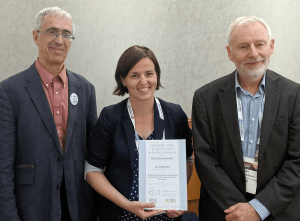
Ruth Dassonneville (Centre) and Ian McAllister (right) receiving their award from André Blais of the University of Montréal (left) at APSA in Washington D.C., August 2019.
Article Title: “Gender, Political Knowledge, and Descriptive Representation: The Impact of Long-Term Socialization”
Article Citation: Dassonneville, R. & McAllister, I. (2018). “Gender, Political Knowledge, and Descriptive Representation: The Impact of Long-Term Socialization”. American Journal of Political Science, 62 (2), pp. 249-265.
DOI: https://doi.org/10.1111/ajps.12353
Article Abstract: Successive studies have found a persistent gender gap in political knowledge. Despite much international research, this gap has remained largely impervious to explanation. A promising line of recent inquiry has been the low levels of women’s elected representation in many democracies. We test the hypothesis that higher levels of women’s elected representation will increase women’s political knowledge. Using two large, comparative data sets, we find that the proportion of women elected representatives at the time of the survey has no significant effect on the gender gap. By contrast, there is a strong and significant long‐term impact for descriptive representation when respondents were aged 18 to 21. The results are in line with political socialization, which posits that the impact of political context is greatest during adolescence and early adulthood. These findings have important implications not only for explaining the gender knowledge gap, but also for the impact of descriptive representation on political engagement generally.
Award Selection Committee: Henrik Oscarsson (University of Gothenburg, Sweden); Christina Eder (GESIS – Leibniz Institute for the Social Sciences, Germany); Kimuli Kasara (Columbia University, USA).
What the Selection Committee said about Winning Work: “Ruth Dassonneville and Ian McAllister take on a persistent puzzle in electoral research. Several studies document that women know less about politics than men, a fact with troubling implications for the quality of democracy. Gendered inequalities in human capital and access to information explain neither the degree nor persistence of the gender gap in political knowledge. Dassonneville and McAllister observe there is little comparative evidence that increasing female representation reduces gender gaps in political knowledge. They note that the existing literature misses the critical point that political interest is stable over time and results from early political socialization. Using CSES data rigorously and transparently they show that the gender gap in knowledge is smallest when women are better represented in parliament during formative years, which is when a respondent is between the ages of 18 and 21. Interestingly, the gender gap declines because men become less knowledgeable about politics. Considered together the findings in this excellent paper suggest new avenues for research on gender and descriptive representation.”
2018: André Blais, Eric Guntermann and Marc Bodet

Eric Guntermann (left) and André Blais (Center) receiving their award from Professor John Aldrich of the Duke University (right) at APSA in Boston, September 2018.
Article Title: “Linking Party Preferences and the Composition of Government: A New Standard for Evaluating the Performance of Electoral Democracy”
Article Citation: Blais, A., Guntermann, E., & Bodet, M. (2017). “Linking Party Preferences and the Composition of Government: A New Standard for Evaluating the Performance of Electoral Democracy”. Political Science Research and Methods, 5(2), 315-331.
DOI: http://doi.org/10.1017/psrm.2015.78
Article Abstract: We propose a new standard for evaluating the performance of electoral democracies: the correspondence between citizens’ party preferences and the party composition of governments that are formed after elections. We develop three criteria for assessing such correspondence: the proportion of citizens whose most preferred party is in government, whether the party that is most liked overall is in government, and how much more positively governing parties are rated than non-governing parties. We pay particular attention to the last criterion, which takes into account how each citizen feels about each of the parties as well as the intensity of their preferences. We find that proportional representation systems perform better on the first criterion. Majoritarian systems do better on the other two.
Award Selection Committee: Rachel Meneguello (Universidade Estadual de Campinas, Brazil); Christina Eder (GESIS – Leibniz Institute for the Social Sciences, Germany); Georg Lutz (University of Lausanne, Switzerland).
What the Selection Committee said about Winning Work: “The crisis of representation in contemporary democracies and the limited responses of democratic governments to the demands of the electorates have placed important constraints on the effectiveness of the electoral formulas established in the various countries.
Blais, Guntermann and Bodet develop an original approach for assessing the quality of democracies, both conceptually and empirically, addressing a fundamental question of democracy, namely the correspondence between citizens’ preferences and government composition. The authors use CSES data in an innovative way in search of the effectiveness of electoral systems. Drawing extensively on CSES Modules 1-3 and the April 2015 version of Module 4, the article analyzes a sample of 87 legislative elections held in 35 countries. Using the criterion of party preferences, Blais and his colleagues obtain fundamental findings about whether majoritarian or proportional systems of elections perform better in this regard. One of the most important aspects of the study is that by using the measure of citizens’ ratings of political parties, which is available in most election studies and in all of the studies composing CSES, the authors demonstrate the importance of party preferences for understanding satisfaction with the chosen governments, rather than use of party preferences for explaining strategic considerations of vote choice. The paper fills an important gap in the literature on the performance of electoral systems and its consequences, and especially the impact of the role of parties in the electorate. The authors do not advocate as to which system is best, but establish important foundations on the composition of more representative governments in contemporary democracies”
2017: Dani Marinova

Dani Marinova (right) receiving her award from Professor Orit Kedar of the Hebrew University of Jerusalem (left) at EPSA in Milan, June 2017.
Book Title: “Coping with Complexity: How Voters Adopt to Unstable Parties”
Book Citation: Marinova, D. (2016). “Coping with Complexity: How Voters Adapt to Unstable Parties”. ECPR Press.
Book Overview: When parties undergo abrupt organisational changes between elections – such as when they fuse, split, join or abandon party lists – they alter profoundly the organisation and supply of electoral information to voters. The alternatives on the ballot are no longer fixed but need to be actively sought out instead. This book examines how voters cope with the complexity triggered by party instability. Breaking with previous literature, it suggests that voters are versatile and ingenious decision-makers. They adapt to informational complexity with a set of cognitively less costly heuristics uniquely suited to the challenges they face. A closer look at the impact of party instability on the vote advances and qualifies quintessential theories of vote choice, including proximity voting, direction-intensity appeals, economic voting and the use of cognitive heuristics. The rich and nuanced findings illustrate that political parties hold a key to understanding voter behaviour and representation in modern democracy.
Award Selection Committee: Aida Just (Bilkent University, Turkey); Stephen Quinlan (GESIS – Leibniz Institute for the Social Sciences, Germany); Carlos Shenga (Centre for Research on Governance and Development, Mozambique).
What the Selection Committee said about Winning Work: “Instability of political parties and party systems has become a notable feature of many contemporary democracies. Today political parties emerge, fuse, split, and die off not only in newer democracies, but also in established ones. Marinova’s Coping with Complexity is a timely contribution on a highly salient phenomenon: the emergence of new party organizations and reshuffling of pre-existing ones. It offers a systematic account of party instability and its consequences for citizen electoral behavior. Drawing on insights from a wide range of studies in political psychology and party organizations, Marinova argues that party instability makes it more difficult for voters to acquire information relevant to elections. It also alters voters’ decision-making strategies in response to increased complexity of their electoral environment. Drawing extensively on CSES Modules 1-3 and fusing it with original data on party and party system instability from established and newer democracies 1987-2011, Marinova finds that party instability leads to low-information environment where citizens are more likely to engage in directional-intensity rather than proximity voting, and are more likely to rely on candidate characteristics when casting their votes. Moreover, she shows that citizens are less likely to employ retrospective economic evaluations in their vote choice if parties undergo significant organizational changes.”
2016: Kasara Kimuli and Pavithra Suryanarayan

Kasara Kimuli (right) and Pavithra Suryanarayan (left) receiving their award from Professor John Aldrich of the Duke University (Center) at APSA in Philadelphia, September 2016.
Article Title: “When Do the Rich Vote Less Than the Poor and Why? Explaining Turnout Inequality across the World”
Article Citation: Kimuli, K., & Suryanarayan, P. (2015). “When Do the Rich Vote Less Than the Poor and Why? Explaining Turnout Inequality across the World”. American Journal of Political Science, 59(3), 613-627.
DOI: https://doi.org/10.1111/ajps.12134
Article Abstract: The conventional wisdom that the poor are less likely to vote than the rich is based upon research on voting behavior in advanced industrialized countries. However, in some places, the relationship between turnout and socioeconomic status is reversed. We argue that the potential tax exposure of the rich explains the positive relationship between income and voting in some places and not others. Where the rich anticipate taxation, they have a greater incentive to participate in politics, and politicians are more likely to use fiscal policy to gain support. We explore two factors affecting the tax exposure of the rich—the political salience of redistribution in party politics and the state’s extractive capacity. Using survey data from developed and developing countries, we demonstrate that the rich turn out to vote at higher rates when the political preferences of the rich and poor diverge and where bureaucratic capacity is high.
Award Selection Committee: Orit Kedar (Hebrew University, Israel); Stephen Quinlan (GESIS – Leibniz Institute for the Social Sciences, Germany); Masahiro Yamada (Kwansei Gakuin University, Japan).
What the Selection Committee said about Winning Work: “The question of who turns out to vote has occupied political scientists for decades. It is a particularly important question if voters differ in their political interests from those who stay at home. Conventional wisdom holds that turnout is positively correlated with class: the wealthy vote at higher rates than the poor. In their innovative study, Kasara and Suryanarayan show that there is in fact substantial cross-country variation in class-based inequality of turnout. While in many countries the poor are underrepresented among voters, in others the rich stay at home at disproportionately high rates. The authors utilize data from the CSES and supplement it with additional cross-country surveys as well as with additional sources of data about the state to conduct a broad cross-country analysis. They employ a classic two-stage analysis in which they first estimate the effect of income on turnout at the individual level and then systematize the variation in the effect with characteristics of the state. The authors show that the greater the extractive capacity of the state and the divergence of preferences between rich and poor, the more likely are the rich to turn out compared to the poor. The study is an outstanding example of theoretically innovative and empirically sound research that utilizes CSES data to investigate the relationship between important micro-level regularities and macro-level conditions. With an exciting argument which brings together insights from different fields and rigorous analysis, Kasara and Suryanarayan’s work not only significantly adds to the extensive body of knowledge on turnout and inequality in turnout but also opens new avenues for comparative research.”
2015: Noam Lupu

Noam Lupu whose work was honored at ECPR in Montréal, August 2015.
Article Title: “Party Polarization and Mass Partisanship: A Comparative Perspective”
Article Citation: Lupu, N. (2015). “Party Polarization and Mass Partisanship: A Comparative Perspective”. Political Behavior, 37(2), 331-356.
DOI: https://doi.org/10.1007/s11109-014-9279-z
Article Abstract: Scholars view polarization with trepidation. But polarization may clarify voters’ choices and generate stronger party attachments. The link between party polarization and mass partisanship remains unclear. I look to theories of partisanship to derive implications about the relationships among polarization, citizens’ perceptions of polarization, and mass partisanship. I test those implications using cross-national and longitudinal survey data. My results confirm that polarization correlates with individual partisanship across space and time. Citizens in polarized systems also perceive their parties to be more polarized. And perceiving party polarization makes people more likely to be partisan. That relationship appears to be causal: using a long-term panel survey from the United States, I find that citizens become more partisan as they perceive polarization increasing.
Award Selection Committee: Rachel Meneguello (Universidade Estadual de Campinas, Brazil); Markus Quandt (GESIS – Leibniz Institute for the Social Sciences, Germany); Zeynep Somer-Topcu (Vanderbilt University, USA).
What the Selection Committee said about Winning Work: “An ongoing stream of analysis using Comparative Study of Electoral System (CSES) data investigates the link between political parties and voters, often with a view towards assessing the potential costs and benefits regarding the overall quality of democratic representation. The combination of soundly researched results and relevant, normative questions about democratic systems is a hallmark of many of the best of CSES-based publications. This year’s award winning work is another exemplar of this special combination. Noam Lupu’s article ‘Party Polarization and Mass Partisanship: A Comparative Perspective’ provides a fresh look at the effects of party polarization, i.e. the programmatic or ideological distance among political parties of a certain political system at any given point in time. While the conventional wisdom holds polarization to be detrimental to the quality of governance, and to eventually disengage citizens from their polity, Lupu shows that polarization can also have markedly positive effects. Polarized party positions increase the clarity of choice for the voters. Party polarization also is related to an increased sense of relevance as to what happens in the political arena. If subjective stakes are higher, so should be the willingness to invest effort, time, skills, and emotion into politics, and thus into the subjective attachment to parties. Lupu confirms these core hypotheses using research with unprecedented breadth, extremely careful development of necessary micro-level and macro-level theoretical reasoning, and using state of the art statistical methodology. Lupu’s work investigates these effects not only using CSES data in a cross-national perspective, but also with longitudinal data from the American National Election Studies and individual-level panel data from the U.S. Political Socialization Study. In the paper, the construct of party polarization is not only measured by aggregating individual-level data, but also by coding party programs into ideological distance measures. The robustness of the results to all of this methodological variation is impressive.
In sum, the awarded work adds significantly and in innovative ways to the body of knowledge about the reasons behind differences in mass partisanship. It is in all respects a commendable and impressive use of the CSES.”
2014: Richard R. Lau, Parina Patel, Dalia F. Fahmy and Robert R. Kaufman

Richard R. Lau (Center left) and Dalia F. Fahmy (Center right) receiving their award from Professor André Blais University of Montréal (right) and Dr. Stephen Quinlan (GESIS, left) at APSA in Washington D.C., August 2014.
Article Title: “Correct Voting Across Thirty-Three Democracies: A Preliminary Analysis”
Article Citation: Lau, R. R., Patel, P., Fahmy, D. F., & Kaufman, R. R. (2014). “Correct Voting Across Thirty-Three Democracies: A Preliminary Analysis”. British Journal of Political Science, 44(02), 239-259.
DOI: https://doi.org/10.1017/S0007123412000610
Article Abstract:This article extends Lau and Redlawsk’s notion of correct voting – whether voters, under conditions of uncertainty, choose the alternative they would have chosen had they been fully informed about the issues and candidates in that election – to sixty-nine elections in thirty-three established and emerging democracies around the world. At the individual level, political sophistication, political experience and motivation all significantly predict the probability of casting a correct vote. However several institutional factors proved to be even more important. In particular, elections with more parties running – and settings that encourage candidate-centred voting – decrease the probability of correct voting, while more ideologically distinctive alternatives, clearer lines of responsibility and greater media access to information are associated with higher rates of correct voting.
Award Selection Committee: Russ Dalton (UC Irvine, USA); Markus Quandt (GESIS – Leibniz Institute for the Social Sciences, Germany); Rachel Gibson (University of Manchester, United Kingdom).
What the Selection Committee said about Winning Work: “The Lau et al. article represented a very original use of the CSES data and a significant contribution to the research literature on elections. The authors utilize the CSES project to examine the interaction of institutional context and individual political behavior in terms of “correct voting”: the degree to which the actual votes cast match with what an individual voter should have voted for under the never-fulfilled condition of perfect information about the available options. This concept initially developed in the U.S. argues that electoral rules and institutions have important consequences for the propensity of voters to vote ‘correctly,’ meaning, to vote according to their own subjective interest. In the awarded work, the authors make excellent use of the CSES not only to examine its validity and robustness in many observations – they also systematically extend it to reflect the effects of varying party systems and electoral contexts. The article is theoretically well-founded, analytically rigorous, methodologically sophisticated, and has significant empirical results. In addition to the common individual-level predictors, several institutional factors prove to be important. In particular, the effective number of parties and settings that encourage candidate-centered voting decrease the probability of correct voting. Conversely, more ideologically distinctive alternatives, clearer lines of responsibility and greater media access to information are associated with higher rates of correct voting.”
2013: Mark A. Kayser and Michael Peress

Mark A. Kayser (left) and Michael Peress (right) receiving their award from Professor André Blais University of Montréal (Center) at APSA in Chicago, September 2013.
Article Title: “Benchmarking across Borders: Electoral Accountability and the Necessity of Comparison”
Article Citation: Kayser, M. A., & Peress, M. (2012). “Benchmarking across Borders: Electoral Accountability and the Necessity of Comparison”. American Political Science Review, 106(03), 661-684.
DOI: https://doi.org/10.1017/S0003055412000275
Article Abstract: When the economy in a single country contracts, voters often punish the government. When many economies contract, voters turn against their governments much less frequently. This suggests that the international context matters for the domestic vote, yet most research on electoral accountability assumes that voters treat their national economies as autarkic. We decompose two key economic aggregates—growth in real gross domestic product and unemployment—into their international and domestic components and demonstrate that voters hold incumbents more electorally accountable for the domestic than for the international component of growth. Voters in a wide variety of democracies benchmark national economic growth against that abroad, punishing (rewarding) incumbents for national outcomes that underperform (outperform) an international comparison. Tests suggest that this effect arises not from highly informed voters making direct comparisons but from “pre-benchmarking” by the media when reporting on the economy. The effect of benchmarked growth exceeds that of aggregate national growth by up to a factor of two and outstrips the international component of growth by an even larger margin, implying that previous research may have underestimated the strength of the economy on the vote.
Award Selection Committee: Catherine de Vries (University of Geneva, Switzerland); Markus Quandt (GESIS – Leibniz Institute for the Social Sciences, Germany); Nicolas Sauger (Sciences Po, France).
What the Selection Committee said about Winning Work: “The winning article represents a major contribution to the economic voting literature both in terms of theory and results. In addition, it moves the field forward in presenting a theoretical framework that allows for more consistent interpretation of existing work. By analyzing national economic performance and its impact on governmental electoral support, the authors hypothesize and empirically substantiate that voters are not completely myopic. Rather they form voting preferences on the basis of meaningful assessments of incumbent governments’ performance. In addition, by building on insights from the field of fiscal federalism, Kayser and Peress show that voters are able to compare economic performance across territories. Voters evaluate incumbent performance in terms of the degree to which national outcomes are better or worse than an international benchmark, and punish (or reward) incumbents accordingly. The effect of this benchmarking is strong and robust, and not confined to an elite of highly educated or informed voters, but mainly driven by the media. The idea, though simple, is original and thought-provoking while the empirical testing is rigorous and yet careful. Utilizing the full breadth of the Comparative Study of Electoral Systems program data, and elegantly combining it with macro-economic data, the article presents a showcase of how to address important scientific puzzles concerning political behavior in a cross-national manner while effectively using the CSES data to the highest methodological standards. The article demonstrates once more how CSES data can contribute not only to scientific, but also to key societal, debates.”
2012: Russell J. Dalton, David M. Farrell and Ian McAllister

Ian McAllister (right) receiving his award from Professor André Blais University of Montréal (left) at APSA in New Orleans, September 2012.
Book Title: “Political Parties and Democratic Linkage. How Parties Organize Democracy”
Book Citation: Dalton, R. J., Farrell, D. M., & McAllister, I. (2011). Political Parties and Democratic Linkage. How Parties Organize Democracy. Oxford University Press.
DOI: https://doi.org/10.1093/acprof:osobl/9780199599356.001.0001
Book Overview: Is the party over? Parties are the central institutions of representative democracy, but critics increasingly claim that parties are failing to perform their democratic functions. This book assembles cross-national evidence to assess how parties link the individual citizen to the formation of governments and then to government policies. Using the Comparative Study of Electoral Systems and other recent cross-national data, the chapters examine the workings of this party linkage process across established and new democracies. Political parties still dominate the electoral process in shaping the discourse of campaigns, the selection of candidates, and mobilizing citizens to vote. Equally striking, parties link citizen preferences to the choice of representatives, with strong congruence between voter and party Left/Right positions. These preferences are then translated in the formation of coalition governments and their policies. The book argues that the critics of parties have overlooked the ability of political parties to adapt to changing conditions in order to perform their crucial linkage functions. As the context of politics and societies have changed, so too have political parties. This text argues that the process of party government is alive and well in most contemporary democracies.
Award Selection Committee: Sara Hobolt (London School of Economics, United Kingdom); Markus Quandt (GESIS – Leibniz Institute for the Social Sciences, Germany); Jeffrey Karp (University of Exeter, United Kingdom).
What the Selection Committee said about Winning Work: “This book examines the role of parties in the process of democratic representation by analyzing each of the linkages between citizens and policy outcomes: the campaign linkage, the participatory linkage, the ideological linkage, the representative linkage and finally the policy linkage. It thus explores a fundamental question to the study of democracy, namely how do parties help organize the representation of citizens. In contrast to much of the recent literature that argues that parties are in decline, the book provides an impressive defense of the importance of parties by showing that they perform a crucial function in the democratic process, and that they continue to do so because of their ability to adapt to changing conditions. The book provides a substantively and theoretically important contribution to the literature on democratic politics. It can be expected to encourage further discussion about the role of parties in contemporary societies. It also presents an ideal showcase of the type of questions that can be answered with data from the Comparative Study of Electoral Systems program, and how they can contribute not only to scientific but also to societal debates. The lucid presentation of the data (both descriptive and statistical models) and the concise argumentation that ties together the different perspectives on democratic representation make this book very accessible to readers.”
2011: Matt Golder and Jacek Stramski
Article Title: “Ideological Congruence and Electoral Institutions”
Article Citation: Golder, M., & Stramski, J. (2011). “Ideological Congruence and Electoral Institutions”. American Journal of Political Science, 54(1), 90-106.
DOI: https://doi.org/10.1111/j.1540-5907.2009.00420.x
Article Abstract: Although the literature examining the relationship between ideological congruence and electoral rules is quite large, relatively little attention has been paid to how congruence should be conceptualized. As we demonstrate, empirical results regarding ideological congruence can depend on exactly how scholars conceptualize and measure it. In addition to clarifying various aspects of how scholars currently conceptualize congruence, we introduce a new conceptualization and measure of congruence that captures a long tradition in democratic theory emphasizing the ideal of having a legislature that accurately reflects the preferences of the citizenry as a whole. Our new measure is the direct counterpart for congruence of the vote‐seat disproportionality measures so heavily used in comparative studies of representation. Using particularly appropriate data from the Comparative Study of Electoral Systems, we find that governments in proportional democracies are not substantively more congruent than those in majoritarian democracies. Proportional democracies are, however, characterized by more representative legislatures.
Award Selection Committee: John Aldrich (Duke University, USA); Markus Quandt (GESIS – Leibniz Institute for the Social Sciences, Germany); Ian McAllister (Australian National University, Australia).
What the Selection Committee said about Winning Work: “In the article, Golder and Stramski test an innovative conceptualization and measurement of ideological congruence, which they argue, more accurately captures the notion of a legislature reflecting the ideological preferences of the citizenry as a whole. They use data from CSES Modules 1 and 2 to test their expectations and find that governments in proportional representation (PR) systems are not necessarily more ideological congruent than those in single-member district (SMD) systems; however, they argue that proportional representation (PR) systems tend to produce more representative assemblies. This article makes three important contributions to cross-national comparative research: 1) the conceptualization of congruence can be exported to countries beyond the CSES dataset, 2) it offers important insights into the debate about the relative merits of proportional representation (PR) and single-member district (SMD) systems, and 3) it has important implications for the study of representation, especially issues of conceptualization and measurement.”