
The 2025 GESIS Klingemann Prize for the Best CSES Scholarship was awarded to Luana Russo and Paula Schulze Brock for their article “Mainstream partisans’ affective response to (non) cooperation with populist radical right parties” in Western European Politics. We are grateful that they have provided the following written summary of their award-winning research.
Mainstream partisans’ affective response to (non) cooperation with populist radical right parties
by Luana Russo and Paula Schulze Brock
In recent years, the rise of populist radical right parties (PRRPs) has forced mainstream parties to confront a strategic choice. Across Europe, these parties have entered parliaments, shaped political agendas, and, in some cases, supported or joined governments. Faced with this reality, mainstream parties have often taken one of two paths: either draw a clear line and refuse any cooperation (a cordon sanitaire), or engage—sometimes reluctantly—with these actors.
Debates about these choices often focus on policy or democratic principles. But they also raise a more immediate question: what effect do these strategies have on how citizens feel about radical right parties?
This question matters because contemporary democracies are not only structured by ideological disagreement, but also by affective divisions—how much citizens like or dislike parties and political actors. It is well known that PRRPs, in particular, tend to elicit strong negative reactions among large parts of the electorate. Yet these reactions are unlikely to be fixed. A large body of research shows that elite signals play a crucial role in shaping how citizens evaluate political actors.
Our study starts from this intuition. Drawing on research in political behaviour and social psychology, we argue that mainstream party strategies act as powerful social cues. When mainstream parties refuse to cooperate with a PRRP, it signals that this party lies outside the boundaries of acceptable politics. Conversely, when they cooperate—whether formally in government or informally through parliamentary support—this may signal that the party is a legitimate political actor.
To examine these dynamics, we rely on data from the Comparative Study of Electoral Systems (CSES), which allows us to analyse citizens’ attitudes across countries and over time. We combine this with information on whether PRRPs are excluded or included in governing arrangements across 13 Western European countries between 1996 and 2019.
Our findings show a clear and consistent pattern. When PRRPs are excluded by mainstream parties, they are evaluated more negatively by supporters of mainstream parties. Exclusion appears to reinforce their status as stigmatized actors, amplifying feelings of dislike. By contrast, when mainstream parties cooperate with PRRPs, citizens’ evaluations become significantly more positive. This shift is particularly pronounced among supporters of the parties directly involved in cooperation, but it also extends more broadly across the electorate.
under exclusion vs cooperation
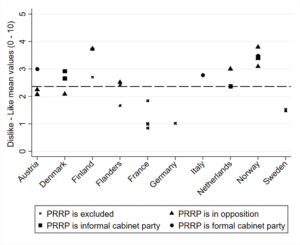
In other words, these results suggest that political strategies do more than structure coalition formation or policy outcomes—they also shape the emotional responses citizens develop towards political actors. In this sense, cooperation can contribute to the normalization of the radical right—not necessarily by changing citizens’ core beliefs, but by sending signals about what is socially and politically acceptable.
At the same time, cross-national data provide only a partial picture. While they allow us to compare contexts, they are less suited to capturing how attitudes evolve within individuals as political circumstances change. To address this, we complement our analysis with longitudinal data from the LISS panel in the Netherlands, which tracks the same individuals over time.
This second analysis allows us to observe what happens when cooperation begins—and when it ends.
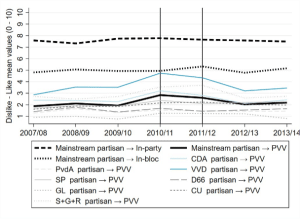
The Dutch case is particularly informative because it includes a period of informal cooperation between mainstream parties and the radical right Party for Freedom (PVV), followed by a breakdown of this arrangement. The results mirror the cross-national findings but add an important dynamic dimension. When cooperation with the PVV is established, citizens’ evaluations of the party become more positive. However, when cooperation ends, these evaluations decline again. The normalization effect associated with cooperation appears to be reversible: when the signal of legitimacy is withdrawn, negative attitudes re-emerge.
and after cooperation
These findings point to a broader implication. The strong dislike that populist radical right parties often face is not simply a reflection of their ideological positions or voter characteristics. It is also shaped by the political environment—and, crucially, by the choices of mainstream parties.
This creates a fundamental tension. On the one hand, exclusionary strategies may be motivated by a desire to defend democratic norms and to limit the influence of actors perceived as challenging them. On the other hand, these same strategies may reinforce affective divides, deepening hostility between political camps. Conversely, cooperation may reduce these divisions by signaling legitimacy, but it may also contribute to the normalization of actors whose positions remain controversial.
More broadly, our study highlights how citizens rely on political elites to interpret the boundaries of acceptable politics. Individuals do not form their attitudes in isolation; rather, they take cues from how parties interact with one another. As a result, elite strategies have consequences that extend beyond institutional arrangements or policy outcomes: they also shape how political actors are perceived and evaluated.
These findings should be interpreted with caution. The implications of exclusion and cooperation are not normatively equivalent and may vary depending on the type of actors involved and the positions they hold. While cooperation may reduce negative affect toward populist radical right parties, it may also signal acceptance of actors whose stances are in tension with core principles of liberal democracy. Conversely, exclusion may reinforce stigma and negative evaluations, but it may also reflect an attempt to draw normative boundaries within the political system.
In this sense, the choice between exclusion and cooperation is not only strategic but also concerns how political systems define and communicate the limits of acceptable politics. Our findings suggest that these choices shape not only political alignments but also how citizens perceive and emotionally relate to different political actors.